

How MSG is helping manufacturers turn workforce challenges into practical apprenticeship solutions
Manufacturers face growing pressure to find skilled workers, develop existing talent, and prepare for changing technologies. Registered Apprenticeship (RA) offers a proven approach, but employers often need guidance, partnerships, and resources to put programs into practice.
Through multiple U.S. Department of Labor (DOL) Industry Intermediary contracts and technical assistance to Scaling Apprenticeship grantees, Manhattan Strategy Group (MSG) has gained extensive experience helping employers develop and expand RA programs across industries. This work has reinforced the importance of starting with employers' workforce needs and developing tailored solutions rather than taking a one-size-fits-all approach. MSG's recent research for DOL further strengthens the business case for RA, finding that employers can see returns of 40% to 90% on their investments.
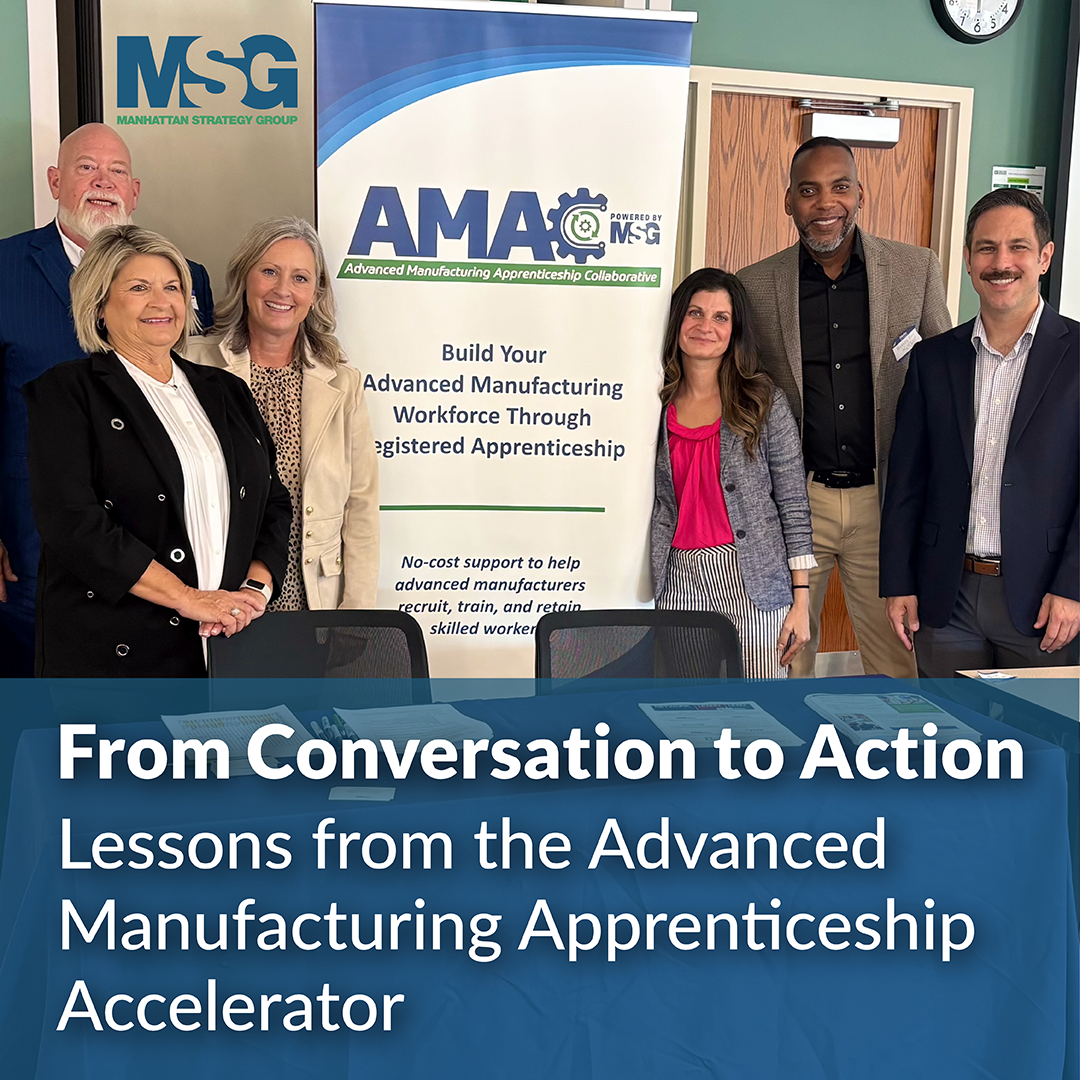
This employer-centered approach shaped the Advanced Manufacturing Apprenticeship Accelerator hosted by MSG through its Advanced Manufacturing Apprenticeship Collaborative (AMAC) at Ivy Tech Community College in Lawrenceburg, Indiana, on October 1, 2026. Held on the first day of Manufacturing Month, the event brought together more than 50 employers, workforce leaders, educators, and government partners to explore practical strategies for building a stronger manufacturing workforce.
Among MSG's first major employer engagement activities as DOL's RA Industry Intermediary for advanced manufacturing, the Accelerator featured remarks from Indiana Department of Workforce Development (DWD) Commissioner Kate Shelby and discussions with apprenticeship leaders, employers, and workforce partners. Three key lessons emerged.
Start with the Employer's Problem, Not the Program
Effective apprenticeship strategies begin by understanding what employers are trying to accomplish. Which positions are hardest to fill? What skills will be needed as technologies evolve? Where can existing workers advance into more technical roles? These questions guide MSG's approach to helping manufacturers identify solutions that align with their business needs, whether developing new RA programs, expanding existing ones, or connecting with training and workforce partners.
"We have to start by listening to employers and understanding what they're trying to accomplish. Apprenticeship isn't a one-size-fits-all solution. The goal is to meet employers where they are, identify what's going to work for their business, and connect them with the right people and resources to make it happen." – Dina Igoe, MSG AMAC Project Manager
Employers Don't Have to Build Apprenticeship Alone
The Accelerator brought employers together to share firsthand experiences with recruitment, mentoring, training, and program implementation. These peer-to-peer conversations offered practical insights into both the challenges and benefits of RA.
"There's real value in getting employers in the room with other employers. They can hear what worked, what was challenging, and what someone else wishes they had known when they started. Those are conversations that are difficult to recreate through a website or presentation." – Paul Negron, MSG AMAC Marketing and Business Development Lead
The discussions also highlighted the importance of partnerships. Ivy Tech Community College provides education and training; the National Institute for Metalworking Skills (NIMS) offers industry-recognized credentials and certifications; River Valley Resources sponsors and manages RA programs for employers; and the Indiana DWD connects businesses with workforce resources. Together, these partners and other stakeholders help employers navigate RA registration, develop training programs, provide funding, and build talent pipelines.
For MSG, facilitating these connections is central to helping manufacturers move from interest in RA to implementation.
Expand the Talent Pipeline from the Inside Out
Building a stronger manufacturing workforce doesn't always mean recruiting new employees. It also means investing in the workers employers already have.
During the Accelerator, automotive components manufacturer Mubea highlighted the value of using RA to develop existing employees for more advanced roles. Internal candidates already understand the business and may be more likely to stay as they see opportunities for long-term career growth.
"Building a strong workforce isn't just about bringing in new talent. Registered Apprenticeship helps us invest in our existing employees, develop their skills, and create opportunities for career advancement. We've found that employees who grow within the company often stay longer because they see a future here." — Olivia Groeschen, Human Resources Business Partner II, Mubea
Participants also emphasized the value of connecting high schools, community colleges, and pre-apprenticeship programs with employers to create pathways into manufacturing careers.
Turning Conversations into Action
The Lawrenceburg Accelerator reinforced an important lesson from MSG's work with manufacturers: expanding RA requires more than awareness. It takes an understanding of employer needs, practical technical assistance, and partnerships that help turn ideas into sustainable programs. Through AMAC, MSG and its partners are building on these conversations to help manufacturers develop new RA programs, expand existing opportunities, and strengthen the advanced manufacturing workforce.